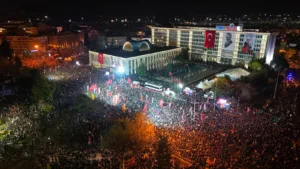
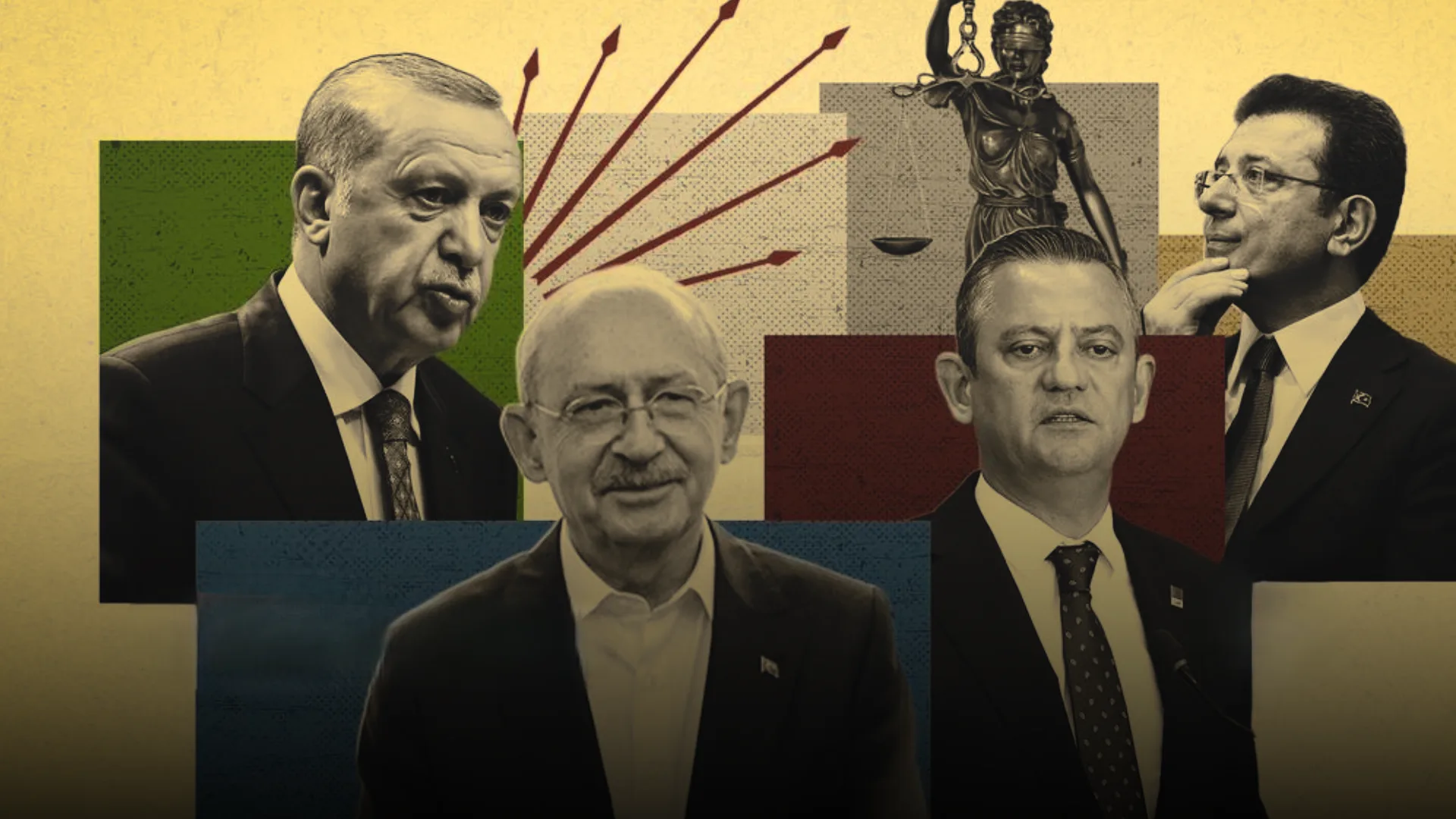
The judiciary of the totalitarian regime has declared the 38th Congress of the CHP absolutely null and void (void ab initio) and appointed Kemal Kılıçdaroğlu, the former CHP leader, as trustee to the party. As will be remembered, on March 19, 2025, Istanbul Metropolitan Municipality Mayor Ekrem İmamoğlu –whose university diploma had been revoked the day before– was detained and arrested, followed by an attempt to appoint trustees to both the municipality and the CHP. However, students gathering in front of Istanbul University, breaching through police barricades paved the way for the anger accumulated in society over many years to spill into the streets. Under the pressure created by the ensuing mobilization of the working masses, Özgür Özel and the CHP leadership adopted a more resilient stance, forcing the regime to back down from its trustee decision at that time.
Politics is a struggle for power; indeed, what forced the regime to back down, albeit temporarily, was the transformation of societal anger into a material force on the streets. However, the CHP leadership failed to channel the unrest and anger erupting across broad segments of society –particularly among opposition circles– into a struggle that would actually push back the regime; instead, it dissipated this anger through rhetorical rallies and neutralized it within the systemic channels of the order. As the mass movement retreated during this process, a sense of pessimism and the feeling that “nothing is changing” descended upon society once again. Under these conditions, calculating that the chaos triggered by the Iran war and the masses’ search for order provided a strategic advantage, the regime launched a full-frontal assault despite all the adversities in the economy.
It is patently clear that Kılıçdaroğlu –appointed as a trustee to the CHP through the ruling of absolute nullity (void ab initio)– along with the statist-nationalist cliques gathered around him, have de facto become an integral component of the regime.
For a government steeped in corruption from head to toe to launch an operation against the CHP under the guise of “fighting corruption” is the height of hypocrisy. Undoubtedly, corruption is inherent to the very fabric of this order; capitalism is a system of exploitation and corruption. All municipalities serve as significant hubs for the urban rent and corruption inherent in the bourgeois order. Yet, when it comes to corruption, the AKP –which has wielded absolute power for over 20 years– and its regime partners stand in a league of their own! The revolutionary working class opposes all forms of exploitation and corruption. The overwhelming majority of society in Turkey is well aware that the real issue is not corruption. The regime seeks to crush all forms of opposition, bypass the electoral mechanisms that could corner it, and consolidate its own survival at any cost.
How was this regime established, and what does it aim to achieve?
Unless we understand how this regime was established, its essential nature, and what it aims to achieve, a correct line of social struggle against it cannot be organized.
Forged during the chaotic process that began with the non-recognition of the June 7, 2015 election results, and was de facto institutionalized under the State of Emergency (OHAL) following July 15, 2016, this regime then consolidated its power. The April 16, 2017 referendum enabled it to secure its constitutional foundations. Kılıçdaroğlu, at the helm of the CHP at the time, tacitly sanctioned the regime’s institutionalization by failing to challenge the blatant fraud during the referendum. Rising upon an alliance between the AKP, the MHP, and Ergenekon-affiliated and Eurasianist Kemalist cliques, this regime liquidated the already fragile bourgeois parliamentary system and concentrated all state power in the hands of Erdoğan.
No matter which way we look at it, this is not an ordinary bourgeois regime. What we face is a fascist regime with its own unique characteristics –one that was born with a weak character from its inception and remains fraught with vulnerabilities. To be sure, this regime was not born through the political self-expropriation of the bourgeoisie out of fear, as happens when the class struggle sharpens and a revolutionary offensive of the working class threatens the capitalist order. However, one must not forget that the conditions propelling fascism to power are those in which the capitalist system faces profound crises and dead-ends. Today, there may not be a revolutionary working-class movement similar to those of the periods that birthed classical fascisms; yet, we are traversing an era where capitalism has reached its historical limits–a period where the crisis of imperialist hegemony and the Third World War overlap, shaking the system with colossal crises. Indeed, while bourgeois democracy worldwide becomes increasingly reactionary and turns into a hollowed-out shell, fascist movements are on the rise and oppressive, authoritarian regimes are being established. Furthermore, we are witnessing successive waves of working-class uprisings that have linked together over the last 25 years. In other words, under the conditions of capitalism’s historical impasse, the potential struggle of the working class and the toiling masses remains the decisive factor in shaping bourgeois politics.
The current conditions of capitalism have profoundly influenced and become a decisive factor in the strife within the Turkish ruling class. This class is a direct participant in the struggle for imperialist hegemony and the Third World War intensifying in the Middle East. The AKP governments and the current fascist regime pursue a policy aimed at ensuring that Turkey, as a sub-imperialist regional power, emerges strengthened and expanded from the imperialist redivision. The war in the Middle East, the intensifying rivalry among imperialist powers, the regionalized Kurdish question, and the ongoing fractures within the Turkish ruling class have formed the objective basis for today’s regime. The alliance composed of the AKP, the MHP, and Ergenekon-affiliated and Eurasianist cliques has solidified as a fascist power bloc; by seizing all political power, it has brought Western-oriented segments of monopoly capital to heel through the coercive apparatus of the state, thereby politically expropriating them.
Of course, this regime has never felt absolutely secure and has always possessed a fragile structure. It has failed to simultaneously suppress all opposition sectors and establish absolute subjugation over society. On the one hand, establishing a fascist regime while, on the other, needing to demonstrate that it derives its legitimacy from elections and the ballot box may seem contradictory, but this is the objective reality. It has pursued this path not by choice, but because it was an objective imperative. Its inability to crush the entire opposition, combined with its need to maintain a veneer of legitimacy through the ballot box, forced the regime to construct a controlled and engineered electoral mechanism.
Despite the absence of a parliamentary regime or a functioning legislature even within a bourgeois-democratic framework, the bourgeois opposition led by the CHP acted as if a normal system were in place simply because the Parliament remained open. The CHP and Kılıçdaroğlu dissipated the rising social anger and pacified the toiling masses by confining the struggle against the regime strictly to the limits of elections and the ballot box. However, the ousting of Kılıçdaroğlu from the CHP leadership, the opposition’s victory in the March 31, 2024 municipal elections, and the emergence of İmamoğlu as a formidable presidential candidate exposed the structural limits of the regime’s controlled election mechanism. It was precisely for this reason that the regime struck on March 19–aiming to fracture the CHP, reduce it to a mere shell party, liquidate İmamoğlu, and crush the entire opposition front standing against it.
Under these conditions, the absolute nullity ruling (void ab initio), which had been postponed due to the masses taking to the streets, was implemented on May 21, 2026. In the intervening period, operations were launched against the metropolitan municipalities of Istanbul, Adana, Bursa, and Antalya, along with dozens of district municipalities; mayors and employees were arrested. By exerting direct pressure on CHP municipalities, the regime has so far managed to force 20 mayors to defect to the ranks of the AKP. Faced with the coercive stick of the state, these bourgeois politicians swallowed the harsh criticisms they had leveled against the regime parties until only yesterday, surrendering to the fascist power bloc to safeguard their own privileges and municipal spoils.
Undoubtedly, the international conjuncture also strengthens the regime’s hand. The US, under the fascist Trump administration –which is driven by its own dictatorial aspirations– extracts every concession it desires from Erdoğan and raises no objection to the domestic consolidation of his regime. Meanwhile, the EU elites –rapidly shifting to the right, becoming increasingly reactionary, and hollowing out the remnants of bourgeois democracy– both need Turkey in the imperialist rivalry and are desperate not to antagonize Erdoğan, who serves as their gendarme in reining in refugees.
Likewise, the backchannel negotiations conducted with Abdullah Öcalan through the state apparatus–despite yielding no lasting results– have led the Kurdish movement to opt for a passive retreat to avoid jeopardizing the so-called process. While this demobilization has inevitably weakened the broader opposition front, it has decisively bolstered the regime’s hand in its all-out assault against the CHP.
The impasse of the CHP as a party of the established order
There is no functioning constitution or judiciary, no binding legal norms, no parliament with a real role, and no ordinary elections –even within a bourgeois framework! The regime seeks to abolish the controlled elections it views as a threat to its existence, or, if it cannot do so entirely, to render them completely farcical and meaningless. While entrenching itself as an absolute power and guaranteeing its survival, it demands that the CHP and other parties of the order serve as the “Majesty’s Opposition.” Kılıçdaroğlu, appointed as a trustee, and many other parties of the established order have already acquiesced to this role. Erdoğan’s goal is to both forge the constitutional path for his re-election and to prevent the emergence of a genuine center of opposition capable of intervening in this process.
However, the CHP under Özgür Özel’s leadership –while claiming it will not play a role within the regime’s framework and refuse to recognize the trustee– remains fundamentally confined within the boundaries of the established order. For instance, it shuns the prospect of “sine-i millet” (returning to the bosom of the people by withdrawing from parliament), a tactic occasionally raised even in bourgeois politics. It harbors no intention of withdrawing from parliament and municipalities in order to organize a struggle where the masses play an active role, declaring the regime illegitimate, cornering it, and forcing its collapse. Consequently, despite the intense resentment of the masses, the leadership instructs them to return home and wait for a call that never comes. While claiming “we will bring life to a halt if necessary”, that “necessity” never quite materializes despite the regime’s all-out offensive. This is because the CHP leadership chooses not to rely on the struggle of the masses, but instead prefers to navigate bureaucratic mechanisms and seek results through elite bargaining at bourgeois summits.
This preference is undoubtedly conscious, but it is also a direct consequence of the CHP’s fundamental impasse. This impasse stems from its nature as a party of the established order. An unbridled mass movement carries the potential to threaten not only the fascist power bloc but also the very bourgeois order upon which the CHP itself rests. The CHP is not merely a bourgeois party; it is the founding institution of the state, with statism deeply ingrained in its very DNA. Indeed, despite emerging from the March 31, 2024 local elections with massive popular support, it made no effort to corner or push back the regime. On the contrary, the leadership under Özgür Özel provided a political lifeline to a cornered Erdoğan through its so-called “normalization” policy. Emboldened and relieved by this breathing space, Erdoğan moved on March 19 to crush the CHP.
Whenever the CHP leadership dares to go slightly further in the struggle and attempts to draw the masses into the political arena, it feels the ground shifting beneath its feet and immediately retreats. Even before the leadership acts on its own, bourgeois circles within and outside the party erupt in outcry, warning that “the path is wrong and dangerous”, thereby dictating its limits and bringing it back into line. Consequently, despite the staggering poverty and social devastation, it cannot even mobilize mass support through a genuinely social-democratic program. Neither its historical Kemalist fetters nor its profound loyalty to the bourgeois order permit such a move. Thus, even when defending the most basic democratic rights, it fails to overstep the boundaries set by the regime. The slogans and songs borrowed from the socialist movement serve as a thin camouflage for the passivity and inadequacy of the CHP leadership. In this climate, rallies staged with pro-democracy rhetoric lack credibility, only deepening the sense of despair among the unorganized masses.
Let us build the independent revolutionary line of the working class!
The socialist movement must, of course, stand as the vanguard against the regime’s onslaught aimed at annihilating all democratic rights and at absolute silencing of society. However, no lasting victory can be achieved as long as the independent revolutionary line of the working class remains unbuilt. If the CHP leadership is to be compelled to take further steps under the pressure of the masses, this will only be possible through the force generated by the socialist movement’s militant, class-based struggle on the ground. The only way for the socialist movement to transcend the boundaries drawn by the CHP, to mobilize the working masses around the colossal problems accumulating in society, and to break today’s vicious circle is through the construction of a revolutionary class front–a labor front. Our goal must not merely be to withstand the regime’s wave of repression, but to imbue all social issues with a radical anti-capitalist content , thereby forging a revolutionary line of struggle against the entire bourgeois order.
This regime has shattered all limits while plundering both labor and nature. Deepening poverty, unemployment engulfing millions, one in every four youths jobless, the encroaching sense of futurelessness, despair, depression, and the escalating violence against women and animals… These crises, manufactured and amplified by the capitalist order and the regime, are suffocating society. Millions of people are marooned in the peripheries of major cities, unable to even reach the city centers; poverty is breeding a devastating state of absolute deprivation. Yet, the socialist movement still lacks the organized strength to transform these burning social agonies into a decisive struggle against the regime and the capitalist system.
The failure of the socialist movement to achieve this does not stem from a lack of theoretical or abstract “revolutionary strategies” proclaimed on paper. The fundamental problem lies in the absence of a revolutionary organization and cadre capable of bringing these truths to life within the very heart of the working class, combined with a persistent detachment from the class itself. The vast majority of the socialist movement fails to undertake the painstaking, persevering, and long-term planned work required to genuinely organize the working-class masses. Consequently, lacking effective and tangible power, it remains unable to exert a decisive influence within the trade union movement. Failing to be decisive in the trade unions, it inevitably fails to be effective within the working class, and by extension, among the toiling masses and society at large. As we have stated, politics is a struggle for power, and the socialist movement today is devoid of this decisive force. A self-proclaimed revolutionary radicalism that never extends beyond a handful of individuals merely yields a sense of self-satisfaction within narrow cadres; it does not forge an organized and enduring power within the working class. This is the crux of the matter; this vicious circle can only be broken by organizing the independent revolutionary line of the working class.