
Foreword
After humanity witnessed the First World War and faced its horrific consequences, it was thought that such wars would never be allowed to happen again. The bourgeois ruling classes, deceiving the masses by claiming “lessons have been learned from history”, brought humanity to the brink of yet another, and much more horrific, destruction just twenty years later. In his novel The Fall of Paris, Ilya Ehrenburg reflects the prevailing sentiment in society around the outbreak of the Second World War as follows:
“It was as though only a single day had passed between the two wars. People thought that everyone had grown wiser after the first war, and believed that henceforth all warmongers would be taught a lesson. Some put their trust in Wilson, others placed all their faith and hope in Lenin. If they had been told then that twenty years later this curse of war would be served up to them again, they would have acted differently!”
The October Revolution of 1917, a beacon of hope for the peoples of the world, deeply influenced the working class, particularly in Western countries, as rebellions and revolutions spread across Europe. However, unfortunately, even though it paved the way for great historical transformations such as the collapse of empires, it did not result in the workers seizing power in European countries outside Russia. This period – in which the working class failed to seize power, while the bourgeoisie could not control the masses or establish order through ordinary methods, and where economic, social, and political crises followed one another – culminated in fascism. Fascist regimes were established in Italy, Germany, Spain, and Portugal; and soon after, humanity was once again dragged into war and destruction. German imperialism, which had armed to the teeth under the fascist regime and been transformed into a colossal economic and military power, allied with Italy and Japan, aiming to avenge its defeat in the First World War, crush Europe and the USSR, block the advance of the US, and establish absolute dominance over the entire world.
Ultimately, in the Second World War, in which even atomic bombs were recklessly deployed over Hiroshima and Nagasaki, 50-55 million civilians were slaughtered alongside 21-25 million soldiers. The bourgeoisie did not care in the slightest about all this suffering and loss. As a result of the second imperialist war, which caused unprecedented destruction and brutality in human history, the crisis of hegemony was resolved, and the dominant power of the imperialist-capitalist world was determined. The US, proving itself as the hegemonic power of the system with its advanced industry, production capacity, financial might, and nuclear weapons, became the undisputed builder of the new world order. By providing financial support for the reconstruction of a war-ravaged Europe and acting as a deterrent nuclear power against the Soviet Union and the “communist danger”, the US succeeded in bringing the capitalist world under its own hegemony. Thus, a new bipolar world order was established, in which imperialist and capitalist states lined up behind the US on one side, while the so-called socialist Eastern Bloc countries aligned behind the USSR on the other. The tensions continuing between these two poles would come to be known as the “Cold War.”
Following the war, the United Nations (UN) organization was established in October 1945 to “maintain international peace and security, and to achieve economic, social, and cultural cooperation.” The imperialist capitalist ruling classes, spreading the lie that an era of perpetual peace would begin thanks to this bourgeois organization, began to deceive the toilers once again. Yet, even though the Second World War had just ended, accompanied by the propaganda of perpetual peace, US imperialism embarked on new wars, massacres, and military coups from Korea to Vietnam.
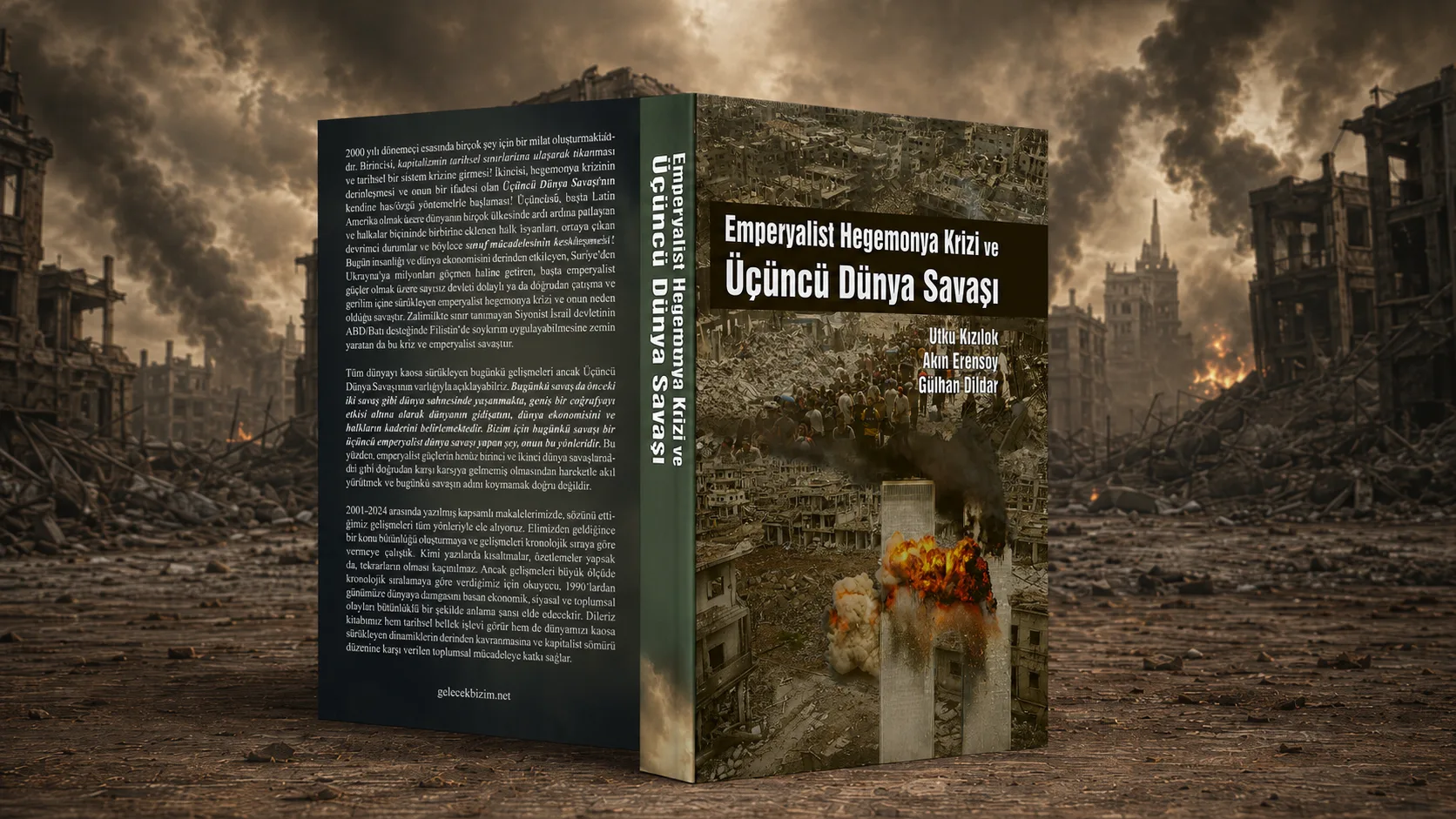
The lie of perpetual peace once again encompassed the social sphere when the USSR collapsed. Bourgeois ideologues were now claiming that an era of unending peace and prosperity would begin! However, with the collapse of the USSR, the existing political balances and alliances in the world disappeared, and the doors to a new era had been opened. The wars waged throughout the 1990s across many regions, from the Caucasus to the Balkans, from the Middle East to Africa, were of the nature of a preparatory phase for a new imperialist world war. The September 11, 2001 attacks on the Twin Towers in New York, US, signaled that the preparatory phase of the Third World War had ended. Indeed, US imperialism used these attacks as a pretext to invade Afghanistan in October 2001 and Iraq in March 2003. Thus, after a 10-year preparatory phase, US imperialism, while its rivals were not yet strong enough, ignited the fuse of the Third World War –which it called an “endless war” –in order to seize control of energy resources, trade routes, and markets, and to strengthen its shaken hegemony.
The turn of the 2000s essentially constitutes a milestone in many respects. First, it is the moment when capitalism, having reached its historical limits and entered an impasse, plunges into a historic systemic crisis! Second, it marks the deepening of the crisis of hegemony and the outbreak of the Third World War –an expression of this crisis– waged through its own unique methods! Third, it signals the popular uprisings erupting one after another and linking up in a chain in many countries of the world, especially in Latin America; the emergence of revolutionary situations; and thus, the sharpening of the class struggle!
The war launched by the USA to overcome the crisis of hegemony at a time when capitalism had reached its historical limits was inherently an imperialist war and could never remain regional. As a matter of fact, the war front in Afghanistan and Iraq expanded to Syria and Libya, from there it reached Eastern Europe and encompassed Ukraine, growing in expanding circles. Under the given conditions, the Middle East is the epicenter of this war. Undoubtedly, the imperialist powers have not yet confronted each other directly, but they are the subjects of the Third World War, which is being waged in various forms. The Third World War is not comprised solely of fronts where tanks and missiles do the talking. Economic sanctions, trade wars, technology restrictions, coups, and civil wars are different forms of this war. Therefore, what deeply affects humanity and the world economy today, shapes international politics from the depths of Africa to Latin America, from the Caucasus to the Asia-Pacific, and drags countless states –first and foremost the imperialist powers– into indirect or direct conflict and tension, is the crisis of imperialist hegemony and the war it has caused. It is also this crisis and imperialist war that provides the groundwork for the Zionist state of Israel, which knows no bounds in its cruelty, to commit genocide in Palestine with US/Western backing.
We can only explain today’s developments, which are dragging the entire world into chaos, through the reality of the Third World War. However, the form that today’s world war has taken over the last 20 years is deceptive and prevents the phenomenon from being namedas such. Bourgeois politicians and ideologues cannot explain how capitalism, historically deadlocked and harboring terrifying contradictions within its depths, is dragging humanity to the abyss. For Marxists, however, the problem must be addressed without being reduced to forms, and it must be grasped that the forms of war also change according to changing conditions. Marxists know very well that the outward appearance of things and their essence do not directly coincide. As Marx pointed out, if outward appearance and essence directly coincided, all science would be superfluous. As is known, the human mind is highly prone to creating forms or molds. By creating forms/molds, human beings think faster and make sense of their surroundings more quickly on the basis of these molds. However, these forms can also hold the human mind captive, preventing it from thinking more freely and evaluating what is happening before its eyes on an objective basis. The human mind, accustomed to established forms, immediately and inevitably looks for the forms it is used to and has memorized when confronted with a new situation, using them as a reference. Indeed, those who look at the first and second world wars and the forms those wars took refrain from defining today’s war as a Third World War simply because it does not assume the exact same forms. Well, must the imperialist powers necessarily confront each other simultaneously and directly for this definition to be made? Is there any obligation for wars to take the exact same forms in every era and every situation?
In the history of class societies, along with the development of the productive forces and technology, the form, method, and intensity of war have also changed. For instance, what determined the outcome of the famous Battle of Kadesh between Egypt and the Hittites, the two superpowers of the ancient world, was the horse-drawn war chariot. With the introduction of the horse-drawn chariot, the speed and intensity of wars changed, and those who possessed these chariots and modified them to use them more effectively gained the upper hand. However, despite the changing instruments, from that time until the mid-19th century, war primarily continued as a colossal pitched battle – a field engagement. After the second half of the 1800s, the rapid development of railways, the invention of the telegraph and the revolution in communications alongside transportation, and the production of steam-powered warships, machine guns, and light artillery brought about a massive change in the speed, intensity, and form of war. Alongside these instruments used in many wars, it was understood that military technology, which was developing at a rapid pace and enabling the introduction of motorized vehicles, would further alter the form of war, increasing its intensity and the devastation it caused. Yet, it still did not provide a comprehensive idea of what a world war could look like. For even though many wars took place, including the Franco-Prussian War of 1870, they were not of a nature to determine the world economy, world politics, and the destiny of the peoples of the world. For a world war to occur, capitalism had to ascend to its imperialist stage. Prior to 1914, the world had been territorially divided among the great powers, primarily Britain and France. With capitalism ascending to the stage of imperialism, the war that began with the explosion of the sharpening contradictions within the bosom of the system inevitably ceased to be regional and became global.
The First Imperialist World War largely took place as a war of trenches, where thousands of people, for example, had to perish just to advance a few hundred meters. Tanks and aircraft, which were introduced toward the end of the war, developed at a terrifying pace in the ensuing years, decisively determining the form and course of war. It would be accurate to call the Second World War a war of tanks, warplanes, and –even if used only by the US– nuclear weapons. As a matter of fact, by looking at the 18 million lives lost in the first war and the 70 million in the second, and the complete leveling of cities –particularly in the latter– we can see the impact of the changing and developing war machines. Both wars deeply affected world politics, the economy, and the destiny of the peoples of the world. The US emerged from the second war as the undisputed hegemonic power of the capitalist world, establishing dominance over the system.
Today’s war, like the previous two wars, is taking place on the world stage, taking a vast geography under its influence and determining the course of the world, the world economy, and the destiny of peoples. For us, what makes today’s war a third imperialist world war is these very aspects. Therefore, it is incorrect to reason from the fact that the imperialist powers have not yet confronted each other directly as they did in the first and second world wars, and to refrain from naming today’s war. Furthermore, everyone acknowledges that it is actually the US-British bloc and Russia fighting in Ukraine. The Western bloc providing Ukraine with long-range missiles to strike the interior of Russia, and Russia’s response with new generation hypersonic missiles after the Ukrainian army used these weapons on November 19, served as a new indicator of who this war is actually between. In this regard, the statement made by Russian President Putin that “the regional conflict in Ukraine provoked by the West has acquired elements of a global character” is sufficiently meaningful.
While these developments were taking place on the Ukrainian front of the Third World War, jihadist groups backed by the US, Israel, and Turkey launched an operation against the Assad regime in Syria on November 27. The 61-year-old Ba’ath regime fell unexpectedly within 10 days. Undoubtedly, with the fall of the Assad regime, the position of countries like Russia, China, and Iran in the Middle East has weakened. However, this picture does not mean that the US-British-Israeli bloc can easily implement their desired plans and establish a stable order in the region in line with their own interests. The destiny of the Middle East, and the countries and powers in this geography, will essentially be shaped according to the outcomes of the Third World War. While attempting to establish a balance in its favor in the Middle East on the one hand, US imperialism is preparing for a major war against China in the Asia-Pacific on the other.
On December 8, the day Assad fell, the official newspaper of the Chinese state, Global Times, stated that the US was preparing for a full-scale war, saying:
“Some US politicians explicitly call for ramping up the production of munitions and establishing hot-production lines to prepare for a «full-scale war» with China. This approach resembles a factory built for war, with its singular purpose being the production of destruction and death. The US industrial base is increasingly being hijacked by the logic of war, turning it into a driver of global tensions. Some US politicians are playing a dangerous game. They seem to believe that military preparations and industrial mobilization will give them an advantage in their confrontation with China. But this thinking is a fatal miscalculation: Full-scale war between great powers means mutual destruction. This suggestion is not a strategic plan at all, but a form of strategic self-destruction. This is akin to playing with matches in a powder keg: You may think you can control the flames, but once a chain reaction begins, the result will be disastrous.”[1]
The US and China are preparing for a major showdown, and it is not necessary to wait for these powers to confront each other directly to apply the concept of the Third World War. It is very clear that a potential war in the Asia-Pacific will not mean the beginning of the Third World War; it will decisively determine the outcomes of this war, which is already ongoing.
The picture above also shows that while the dynamics within the depths of the capitalist order push the imperialist powers toward more direct confrontation by the day, the risk of using nuclear weapons is also increasingly rising. Of course, a nuclear war is not a preferable option, but the contradictions and pressure created by the capitalist order determine the mindset of the rulers, and what seems most inconceivable can appear extremely rational when the day comes. In this regard, to assume that the imperialist ruling classes will not use nuclear weapons based on their destructiveness would be childish! Besides, preparations to use nuclear weapons by narrowing their intensity and area of effect under the name of “tactical nuclear weapons” have been ongoing for a long time. This picture reveals just how serious the dilemma of “socialism or extinction” facing humanity truly is. It is as clear as day that under capitalism, wars will not end, and the solution lies in a struggle for a socialist world.
December 10, 2024
[1] https://www.globaltimes.cn/page/202412/1324596.shtml